

Located in the south of county Wexford, Taghmon takes its name from Teach Munna, meaning the ‘house of Munna’. Its origins lie in the early medieval period when it was home to an important monastic site, which featured prominently in the Irish Annals.
According to tradition this monastery was founded by Saint Munna (St. Fintan) sometime in the early 7th century AD. There are four versions of Saint Munna’s Life, all in Latin, and these suggest that he belonged to the Cinél Conaill, a branch of the northern Uí Néill, whose territory once covered most of Donegal (Culleton 1999, 108). The exact year of his birth is unknown, but it is likely to have been sometime in the late the 6th century, as his death is recorded in AD 634 (Annals of the Four Masters). He was called Fionn, prefixed by Mo, a term of endearment meaning ‘my’. The name Mo-Fhionn-Og, or My Young Fionn became Munna, a name which was sometimes latinised into Fintanus or Fintan, the name by which he is known locally (Culleton 1999, McLoughlin 2020, 4).
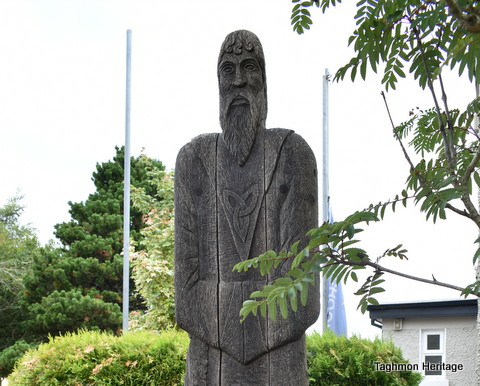
Following his education at various Irish monasteries, Munnu journeyed to the Scottish island of Iona in AD 597, hoping to become a monk there (Culleton 1999, 109). However, he was refused entry and was forced to return to Ireland, where he founded several churches, including Taughmon in Co. Westmeath. He subsequently travelled southwards to Wexford and spent 12 years at a monastery known as Ard Chrema (exact location uncertain). He then went to a place called Achadh Liathdrom (the field on the grey ridge), where the local chief, Dimma Mac Áedh, gave him land to found a monastery (ibid).
This site became known as Teach Munnu (Taghmon) and it quickly developed into a significant religious centre, with some records suggesting that up to 230 monks may have resided there (The Martyrology of Donegal). Its importance can be seen in the Irish Annals, which list a number of abbots and clerics who died there, for example:
AD 777: Ciaran of Teach Munna died (Annals of the Four Masters)
AD 817: Crunnmhael of Tigh Munna (Annals of the Four Masters)
AD 854: Laisren of Tigh Munna died (Annals of the Four Masters)
AD 859: Fiachra, Abbot of Tigh Munna died (Annals of the Four Masters)
AD 885: Dunghal, son of Cathal, Vice Abbot of Teach Munna, died (Annals of the Four Masters)
AD 886: Diarmaid, son of Rui, Abbot of Teach Munna, died (Annals of the Four Masters)
AD 889: Cochlan, Abbot of Teach Munna (Annals of the Four Masters)
AD 925: Soichleachan of Teach-Munna was wounded, and died of the wound (Annals of the Four Masters)
AD 953: Dunlang Mac-Ua-Donnagain, Abbot of Inis-Doimhle and Teach-Munna (Annals of the Four Masters)
AD 1060: Domhnall Deiseach, chief of the Gaedil in piety and charity, died in Tech Munnu (Annals of Inishfallen)
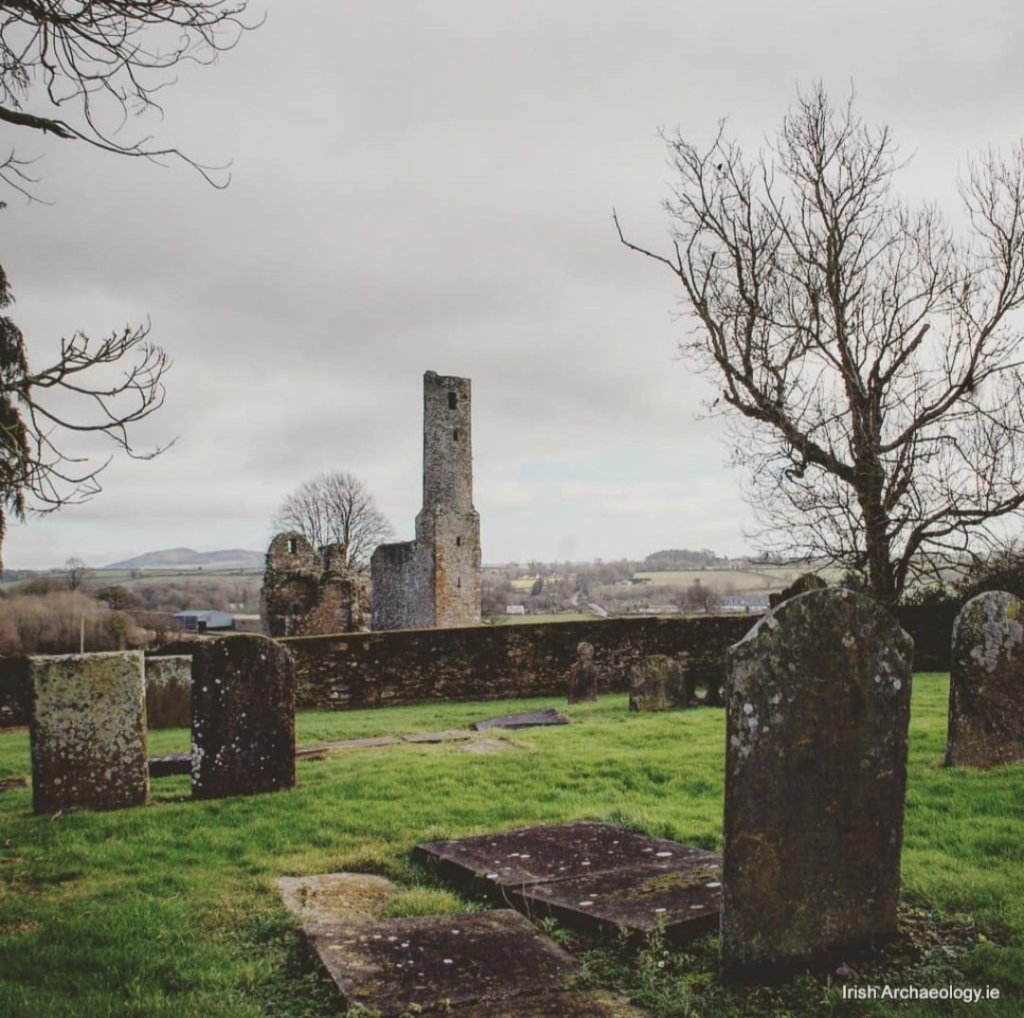
As Taghmon’s power and affluence increased it was slowly drawn into the local political scene. This was most starkly illustrated in AD 817, when the community was involved in a major conflict with the nearby monastery at Ferns (Annals of Ulster). Taghmon lay within the territory of Síl Máeluidir, and their king, Cathal Mac Dulainge, coveted the wealth and prestige of Ferns, which lay within the lands of a rival Uí Cheinnselaig sept, the Síl Chormaic. Spurred on by Cathal, a fierce battle ensued between Taghmon and Ferns in which the community of Taghmon prevailed and over 400 men died.
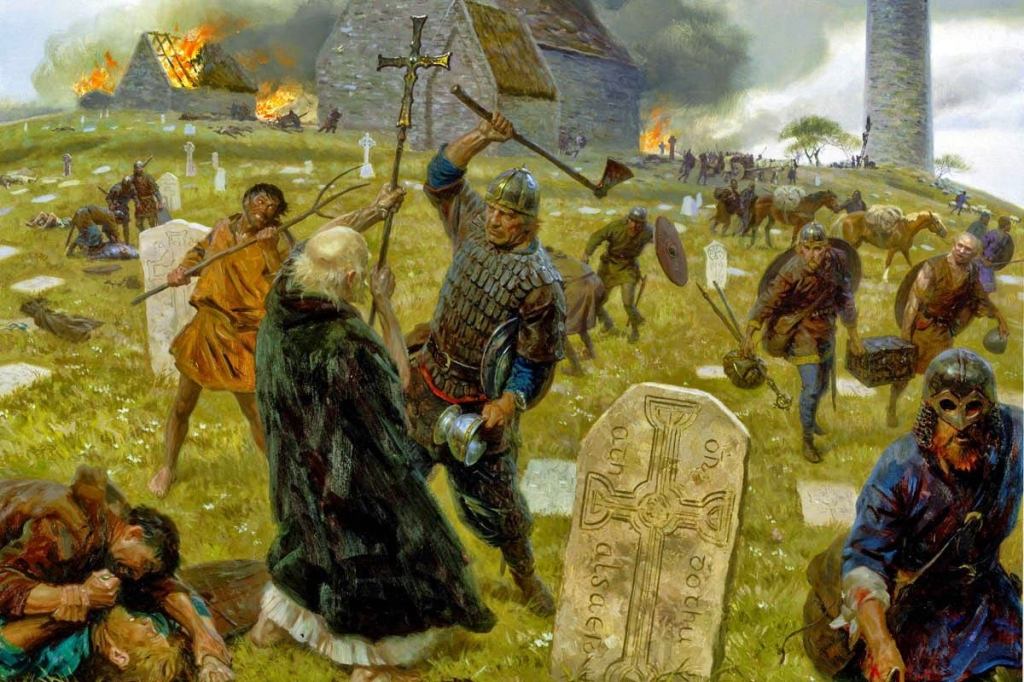
Further bloodshed was to occur in AD 824, when the monastery’s wealth attracted the Vikings (Todd 1867, p. xxxix), and they raided again in AD 828 (Annals of Ulster). However, this time the community of Taghmon rallied around the local Uí Cheinnselaig leader, Cairpre son of Cathal, and together they inflicted a ‘battle route on the heathens‘ (ibid). The monastery appears to have remained largely unmolested for the remainder of the 9th century and it is not until AD 917 when it was once more targeted by the Vikings (Annals of the Four Masters). After this Taghmon’s importance appears to have gradually waned and references to the monastery cease in the late eleventh century.
Early Church Sites
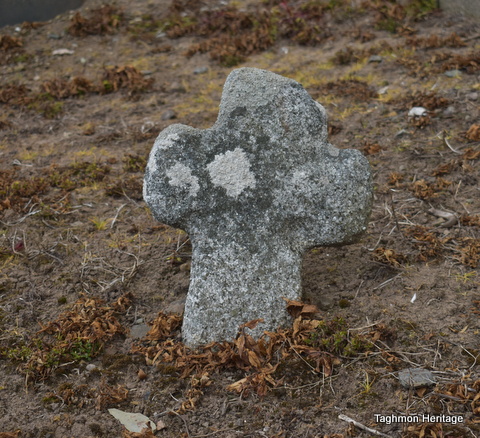
An indication of the former ecclesiastical importance of Taghmon can be seen in the presence of four probable early church sites in the village (Lady’s Church, St. Munna’s/Church of Ireland, The Nunnery and St. Munna’s/The Monnachan). Lady’s church is located on the north-western side of Taghmon and is dedicated to the Virgin Mary. It contains a very badly degraded church gable, a Romanesque window fragment, of probable 12th century date and a small solid-ringed cross of possible 10th/11th century date (See Cortett 2013).
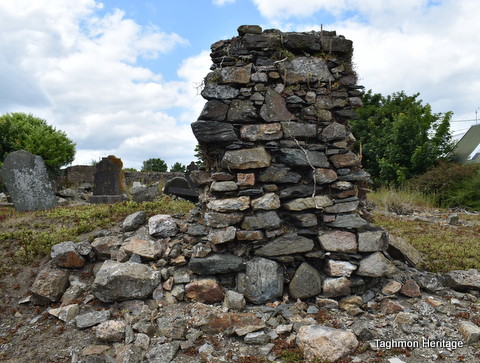
The Record of Monuments and Places (RMP) suggests that the medieval parish church of Taghmon was probably located to the south of Lady’s church, at the site of the present Church of Ireland graveyard. Although there is no evidence of an older structure here, the graveyard does contain a fine 9th/10th century High Cross. Another church site is found to the rear of the Irish Pride bakery and this is known locally as the Monachán. It is located in a small, rectangular graveyard, and local tradition suggests that this may be the original church of Saint Munna. Although a structure was shown here on the first edition Ordnance Survey mapping of 1839, nothing now survives. The surrounding graveyard contains twelve small solid-ringed crosses of possible 10th/11th century date (Corlett 2013) and a large mill-stone which was reused as grave-marker.
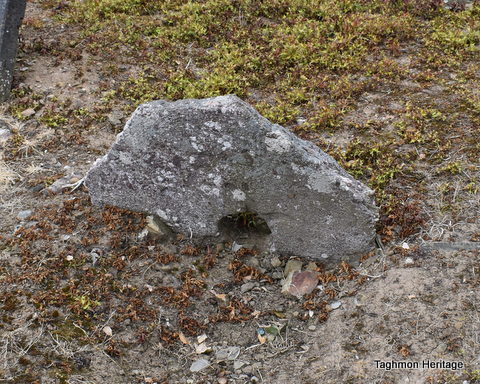
Just outside this cemetery, on its north-eastern edge, are the remains of a rectangular building, which survives in the form of a low earthwork. This is described as a ‘Nunnery’ on the 1st edition Ordnance Survey mapping and may be the site of a pre-Anglo-Norman nunnery which became Arroasian in 12th century (Gwynn and Hadcock 1970, 324). It might also be the site of St Bridget’s church mentioned in 1543, 1558 and 1615, which was part of the possessions of the Knights Hospitallers of Kilcolgan (Hore 1906, 420-21).
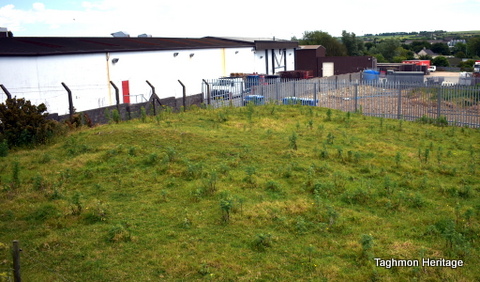
Another characteristic of an early ecclesiastical site is the presence of a large enclosing ditch which would have encircled the monastery. Although now backfilled, evidence for such a feature has been identified at several locations in Taghmon, including Joseph Street (Hardy 2004), Lower Main Street (Sutton 2018) and in agricultural land to the east of the town (Doyle 2016). The extent of this enclosure has been postulated by both Billy Colfer (2013, 28 ) and Ian Doyle (2016, 46) and their research suggests that it may have been over 300m in diameter.
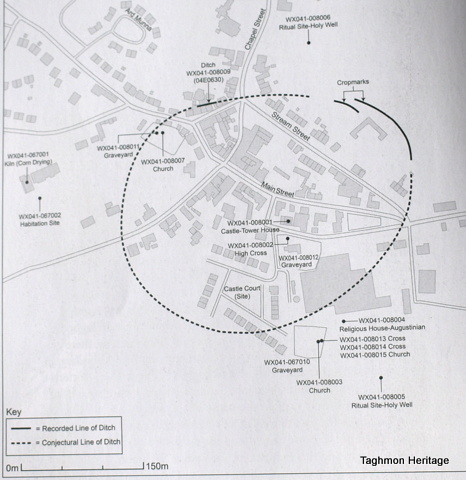
The village also contains two holy wells, St Munna’s on the northeastern side of Taghmon and the Nunnery well on its southeastern edge.
References
Annals = Corpus of Electronic Texts
Corlett, C. 2013 ‘The Taghmon Crosses, Co. Wexford’. In The journal of the Taghmon History Society, No. 10, Wexford, Impression Print, pp. 17-12
Culleton, E. 1999 Celtic and Early Christian Wexford. Dublin: Four Courts Press
Doyle, I. 2016 ‘The archaeology of early medieval Wexford’ in Doyle I & Browne B (eds) Medieval Wexford , Essays in Memory of Billy Colfer, Dublin, Four Courts Press
Gwynn, A. and Hadcock, R.N. 1970 (Reprint 1988) Medieval religious houses of Ireland. Dublin. Irish Academic Press.
Harbison, P. 1992 The high crosses of Ireland: an iconographical and photographic survey, 3 vols. Dublin. Royal Irish Academy. Bonn.
Hardy, C. 2004, ‘2004:1825 – The Village Inn, 5-6 Joseph Street, Taghmon, Wexford’, in Bennett, I. (ed.), Excavation 2004: summary accounts of archaeological excavations in Ireland, in http://www.excavtions.ie/report/2004/wexford/0012945/ accessed 1 August 2021.
Hore, P. H. 1906 History of the town and county of Wexford : The town of Wexford, with a chapter on Taghmon, and a short notice of Harperstown, the ancient seat of the Hore family, London
Ó Broin, G. 1983-4 The holy wells of Wexford. Journal of the Wexford Historical Society 9, 27-35.
Ó Riain, P. 2011 A dictionary of Irish Saints. Dublin. Four Courts Press.
Plummer, C. 1910 Vitae Sanctorum Hiberniae, 2 Vols, Oxford, pp 226-38
McLoughlin, C. 2020 Archaeological Monitoring Report, Cloghulatagh td., Taghmon, Co. Wexford. Unpublished Report for Stafford McLoughlin Ltd.
Sutton, B. 2018 Archaeological monitoring along the Wexford feeder main. Areas 1-13. Licence No. 15E0412. Unpublished report, Irish Archaeological Consultancy
Todd, J. H. 1867 Cogadh Gaedhel re Gallaib, The war of the Gaedhil with the Gaill, or, The invasions of Ireland by the Danes and other Norsemen : the original Irish text, edited, with translation and introduction, London
 Taghmon Heritage